










How to Verify Quality Management Certificates for Your Business

Have you ever hired a vendor, consultant, or partner that claimed to have a quality management certification - only to discover later that it wasn’t legitimate?
It happens more often than most businesses realize.
In a world where digital badges are easy to design, the real challenge isn’t just earning a certificate - it’s ensuring it’s authentic.
For organizations that value credibility, verifying Quality Management Certificates (QMCs) is not a formality - it’s a safeguard. It protects your brand from reputational damage, compliance risks, and costly mistakes.
Why Verification Matters More Than Ever
In today’s market, certification equals credibility.
When a company advertises ISO 9001 or Six Sigma credentials, it signals reliability and quality. But if those credentials aren’t authentic, the results can be disastrous.
According to the ISO Survey, over 1.3 million organizations worldwide hold quality management certifications - yet the number of fake or unverifiable ones is quietly increasing.
The biggest risk isn’t just financial loss. It’s trust erosion.
Once clients or partners discover your team works with unverified entities, your reputation takes a hit that’s hard to repair. In business, trust lost is business lost.
The Hidden Cost of Unverified Certificates
Imagine this scenario.
You partner with a supplier who proudly showcases an ISO 9001 certification. Everything looks professional. Contracts are signed, and production begins.
A few months later, quality issues surface.
After investigation, you learn that the supplier’s certification came from a non-accredited agency. The impact? Damaged relationships, lost credibility, and clients questioning your due diligence.
That’s the real cost of skipping verification.
It’s not just about documents - it’s about protecting your reputation and accountability.
What Is a Quality Management Certificate (QMC)?
A Quality Management Certificate proves that an organization follows structured systems to maintain consistent quality in products and services.
Common examples include:
-
ISO 9001: Focuses on standardized quality management practices.
-
Six Sigma: Reduces defects and process inefficiencies.
-
Total Quality Management (TQM): Emphasizes continuous improvement across departments.
However, not all certificates carry the same weight.
Some are issued by globally accredited agencies, while others come from unauthorized or fake institutions that mimic legitimate organizations.
Knowing how to tell them apart is essential for any responsible business.
How to Verify Quality Management Certificates (Step-by-Step)
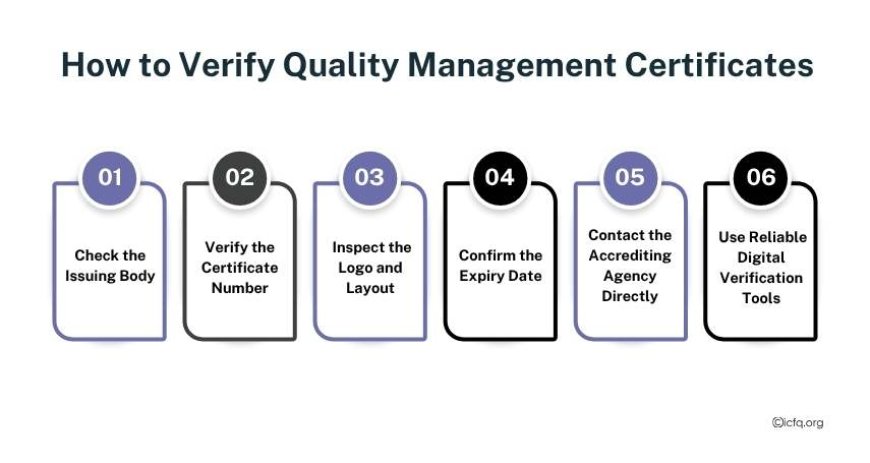
Here’s a practical checklist for ensuring every certificate you receive or review is legitimate and traceable:
1. Check the Issuing Body
Start by confirming whether the certification body is accredited by recognized authorities, such as:
-
IAF (International Accreditation Forum)
-
ISO (International Organization for Standardization)
-
NABCB (National Accreditation Board for Certification Bodies)
Most accredited bodies maintain searchable databases where you can verify if the certifying agency is listed. If it isn’t, proceed with caution.
2. Verify the Certificate Number
Every genuine certificate includes a unique ID or registration number.
Visit the certifying body’s website and use this number to check:
-
Organization name
-
Certificate issue and expiry dates
-
Scope and type of certification
Any mismatched or missing information should be treated as a red flag.
3. Inspect the Logo and Layout
Legitimate certificates use official logos, holograms, and secure digital seals.
Fake ones often feature blurry prints, altered colors, spelling errors, or unauthorized branding. A quick visual check can reveal a lot about its authenticity.
4. Confirm the Expiry Date
Most Quality Management Certificates have a validity period of three years.
Check whether there’s a record of surveillance or renewal audits. If the certificate is outdated, it may no longer hold compliance value.
5. Contact the Accrediting Agency Directly
If you’re unsure, reach out directly to the accrediting body.
Most agencies have dedicated helpdesks or verification portals where you can confirm authenticity. Legitimate agencies are transparent and responsive to such requests.
6. Use Reliable Digital Verification Tools
Technology has made validation simpler and more efficient.
Many accredited organizations now issue blockchain-based or QR-coded certificates that link directly to official registries.
Verifying through these digital systems adds an extra layer of security and reduces the risk of human error.
Red Flags That Signal a Fake Certificate
Stay alert for these common warning signs:
-
No certificate number or contact information for the issuer
-
The certifying body doesn’t appear on the AF or ISO databases
-
Suspiciously low-cost “instant” certifications without proper evaluation
-
Poor formatting, inconsistent fonts, or missing security features
-
No mention of audit frequency or renewal conditions
Authentic credentials are built on evaluation, ethics, and evidence - not shortcuts.
Why You Can’t Afford to Wait
Every month, industries are becoming stricter with compliance and documentation.
Businesses that fail to verify certifications risk being excluded from contracts or procurement opportunities.
Here’s the truth - your competitors are already verifying their partners and team credentials.
By delaying, you’re not just risking compliance - you’re risking credibility.
Clients today look beyond claims. They look for proof. And in a market that rewards trust, verified credentials become your competitive advantage.
Building a Culture of Verified Quality
Verifying quality management certificates is not just an operational task, it’s a strategic decision.
It shows that your business values transparency, accountability, and genuine skill over paper claims.
When your team and partners hold verified certifications, your entire organization stands on stronger ground - one built on confidence and compliance.
Verified Quality Is the Foundation of Trust
In a world flooded with credentials, authenticity is everything.
Verifying quality management certificates protects your business from hidden risks, strengthens your reputation, and demonstrates that you value excellence backed by proof.
Don’t wait for a compliance issue or a failed audit to start checking authenticity.
Begin today - verify, validate, and make trust your strongest asset.
Because in business, quality means little without credibility to match it.