
















How Advantages of Six Sigma Reduce Inefficiencies
Learn how the Advantages of Six Sigma reduce inefficiencies by improving processes, lowering errors, cutting waste, and supporting business growth.

Every business wants smooth processes, fewer errors, and higher customer satisfaction. But many companies still struggle with delays, waste, and repeated mistakes. This is where the Advantages of Six Sigma make a powerful difference. Six Sigma is a proven method that helps organisations reduce problems, control variations, and improve quality using data-driven decisions.
Today, Six Sigma is used across manufacturing, IT, retail, healthcare, logistics, and service-based companies because it brings structure, consistency, and measurable improvements.
What Is Six Sigma? (In Simple Words)
Six Sigma is a business improvement method that helps companies find errors, remove waste, and deliver better quality.
It follows a step-by-step approach called DMAIC:
-
D – Define the problem
-
M – Measure the current performance
-
A – Analyse the root cause
-
I – Improve the process
-
C – Control the results to maintain long-term success
This framework makes sure improvements are not random but based on real data.
What Are Inefficiencies in Business?
Before understanding Six Sigma’s benefits, let’s look at what “inefficiencies” really mean.
Inefficiencies include:
-
Doing the same work twice
-
Too many steps in a simple process
-
Delays in approvals
-
Repeated errors
-
Poor communication
-
Wasting materials
-
Rushing work that leads to mistakes
-
Using outdated methods
-
No clarity in roles and responsibilities
These are small issues, but they add up to large financial losses.
Worldwide research shows:
-
Businesses lose 20–30% of revenue because of inefficiencies.
-
Employees lose up to 2 hours daily due to unclear processes.
-
Companies that remove inefficiencies grow 40% faster than others.
This is why businesses need a strong and structured system like Six Sigma.
How Advantages of Six Sigma Reduce Inefficiencies
Below are the key Advantages of Six Sigma that help reduce inefficiencies in any business.
1. Six Sigma Finds the Real Cause of Problems
Many businesses try to fix problems on the surface. But Six Sigma identifies the root cause, not just the visible issue.
For example:
If product delivery is slow, the real cause may be inventory mismatch, slow approvals, or poor communication. Six Sigma tools help find the exact reason so the business can fix it permanently.
How this reduces inefficiencies:
-
No repeating errors
-
Faster operations
-
More accuracy
-
Better decision-making
2. Six Sigma Standardizes Processes
Businesses face inefficiencies when everyone works differently. Six Sigma creates clear, simple, and repeatable processes.
For example:
Instead of 5 employees doing the same task in 5 different ways, Six Sigma sets one best method.
How this reduces inefficiencies:
-
Less confusion
-
Less waste
-
Faster workflow
-
Better teamwork
This is one of the strongest Advantages of Six Sigma.
3. Six Sigma Reduces Errors and Defects
Errors and defects are the biggest sources of inefficiencies. They create rework, customer complaints, returns, and additional costs.
Six Sigma aims for 99.99966% defect-free performance.
This helps businesses:
-
Reduce mistakes
-
Save time
-
Improve customer satisfaction
-
Increase reliability
This benefit is another major reason companies adopt the Advantages of Six Sigma
4. Six Sigma Makes Data-Based Decisions
Many companies make decisions based on guesses or assumptions. Six Sigma uses data, charts, measurements, and facts.
This avoids:
-
Wrong decisions
-
Delays
-
Misunderstandings
-
Confusion
Data-driven choices help teams work faster and more accurately, reducing inefficiencies.
5. Six Sigma Improves Team Skills and Accountability
Six Sigma provides training programs such as:
-
White Belt
-
Yellow Belt
-
Green Belt
These programs develop skills in:
-
Problem-solving
-
Analysis
-
Communication
-
Leadership
Employees trained in Six Sigma work smarter, reduce mistakes, and handle tasks with more clarity. This is an important Advantages of Six Sigma that boosts productivity.
6. Six Sigma Reduces Time Wastage
Time wasted is common in every company:
-
Waiting for approvals
-
Searching for information
-
Delays in reporting
-
Unplanned meetings
-
Repeated manual tasks
Six Sigma identifies these time-consuming steps and removes them.
This results in:
-
Faster workflow
-
Reduced waiting time
-
Better time management
-
Increased output
This time-saving impact is an essential advantage of Six Sigma
7. Six Sigma Improves Customer Satisfaction
Customers expect:
-
Good quality
-
Fast service
-
Consistent experience
-
Zero errors
Inefficiencies reduce customer trust. Six Sigma helps deliver the same quality every single time.
Benefits for business:
-
More repeat customers
-
Better brand trust
-
Higher reviews
-
More referrals
Customer satisfaction is one of the strongest Advantages of Six Sigma.
8. Six Sigma Helps Reduce Costs
When inefficiencies reduce, costs automatically drop.
Six Sigma reduces costs by:
-
Removing waste
-
Eliminating rework
-
Reducing manpower pressure
-
Lowering defect rates
-
Improving workflow speed
Companies using Six Sigma have reported:
-
Up to 50% cost reduction in some processes
-
Up to 70% fewer defects
-
Up to 35% productivity increase
Cost savings make Six Sigma a high-return investment.
How Six Sigma Supports Business Growth in the Long Term
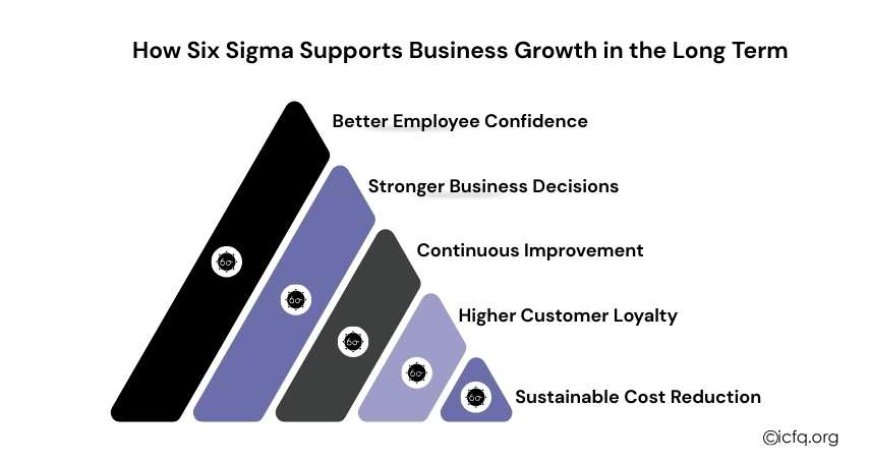
Six Sigma does not give short-term results alone it builds long-term stability. Here’s how:
1. Better Employee Confidence
When employees understand clear processes, they work with confidence and make fewer mistakes. This builds a culture of responsibility and professionalism.
2. Stronger Business Decisions
Six Sigma uses real data, so leaders make decisions based on facts, not assumptions. This reduces financial risk and improves growth planning.
3. Continuous Improvement
Six Sigma creates a culture where teams always look for a better and faster way to do things. This mindset keeps businesses competitive.
4. Higher Customer Loyalty
Customers trust companies that give consistent quality. When inefficiencies drop, customers stay longer, recommend services, and bring new business.
5. Sustainable Cost Reduction
One of the biggest Advantages of Six Sigma is that it saves money for many years.
Even small improvements reduce waste and bring high long-term returns.
How Six Sigma Reduces Inefficiencies Across Industries
Six Sigma has strong results in:
-
Manufacturing
-
Healthcare
-
IT companies
-
Logistics
-
Retail
-
Banking
-
E-commerce
-
Construction
-
Telecom
-
Hospitality
Here’s how:
Manufacturing:
Less scrap, less rework, faster production.
Healthcare:
Less patient waiting time, fewer medication errors.
IT:
Better project delivery, fewer bugs.
Logistics:
Faster delivery, lower transport costs.
Retail:
Better inventory management, reduced mismatch.
Banking:
Faster approvals, lower process delays.
Regardless of the industry, Six Sigma’s result is the same, reduced inefficiencies and improved quality.
Why Businesses Should Adopt Six Sigma Today
Here are the main reasons:
-
Customers demand high quality
-
Competition is strong
-
Profit margins are shrinking
-
Costs are rising
-
Businesses need faster speed and accuracy
Six Sigma gives a clear, structured path to improvement. It helps companies work smarter, not harder.
Six Sigma Is a Powerful Solution for Inefficiencies
Inefficiencies are one of the biggest hidden losses in any business. They waste time, money, and resources every single day. Six Sigma provides a practical and scientific method to remove these issues permanently.
The Advantages of Six Sigma help businesses:
-
Improve speed
-
Reduce waste
-
Lower errors
-
Cut costs
-
Increase customer satisfaction
-
Boost profits
If your goal is to create a smooth, efficient, and high-performing business, then adopting Six Sigma is one of the strongest decisions you can make.